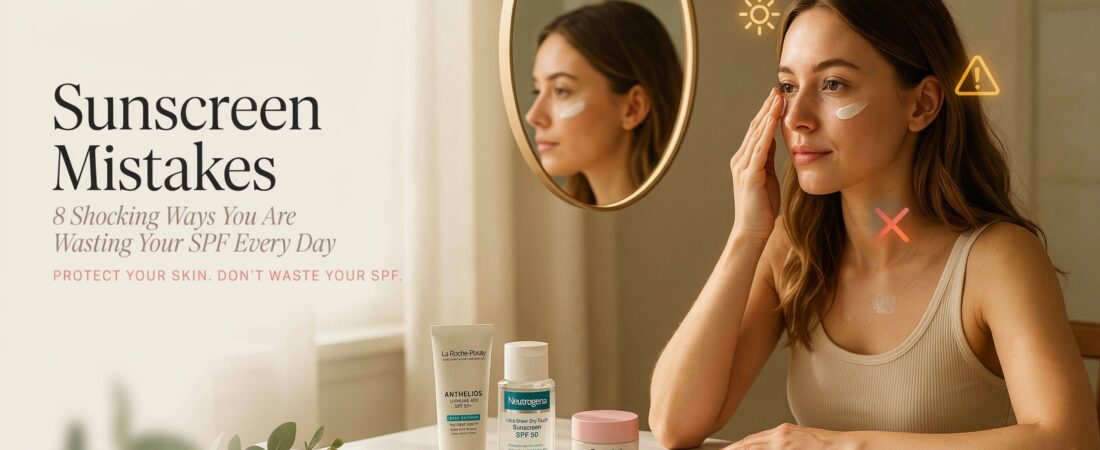
Sunscreen mistakes are quietly undoing everything else you are doing right in your skincare routine – and most people have no idea they are making them.
You bought the SPF. You put it on. You feel like you have done the right thing. But if you are applying it wrong, using the wrong amount, or layering it incorrectly with the rest of your routine, you are getting a fraction of the protection you think you are, and your skin is paying the price every single day.
The frustrating part? These are not complicated mistakes. They are small, fixable habits that most people were simply never taught.
This guide covers the 8 most damaging sunscreen mistakes people make, why each one matters more than you think, and exactly how to apply sunscreen correctly so your SPF actually does its job.
📌 Save this post now. This is the kind of thing you will want to read again every time you start a new sunscreen or rethink your morning routine.
Why Sunscreen Mistakes Matter More Than You Think {#why-it-matters}
The Real Cost of Getting Sunscreen Wrong
Most people think of SPF as optional – the last step they squeeze in on beach days. But UV damage is happening every single day, including on overcast days, when you sit near a window, and during your commute.
UV exposure is responsible for up to 80% of visible skin ageing — the fine lines, dark spots, uneven skin tone, and dullness that no serum can fully reverse once they have set in.
All the niacinamide, vitamin C, and retinol in the world cannot outperform daily unprotected UV exposure. Sunscreen is not the last step of your routine. It is the most important one.
And sunscreen mistakes are the reason it stops working.
Related: Damaged Skin Barrier Symptoms – 7 Warning Signs You Are Ignoring — UV damage is one of the fastest ways to break down your skin barrier. This post covers what to watch for.
8 Sunscreen Mistakes That Are Silently Wasting Your SPF {#mistakes}
Sunscreen Mistake 1 – You Are Not Using Enough
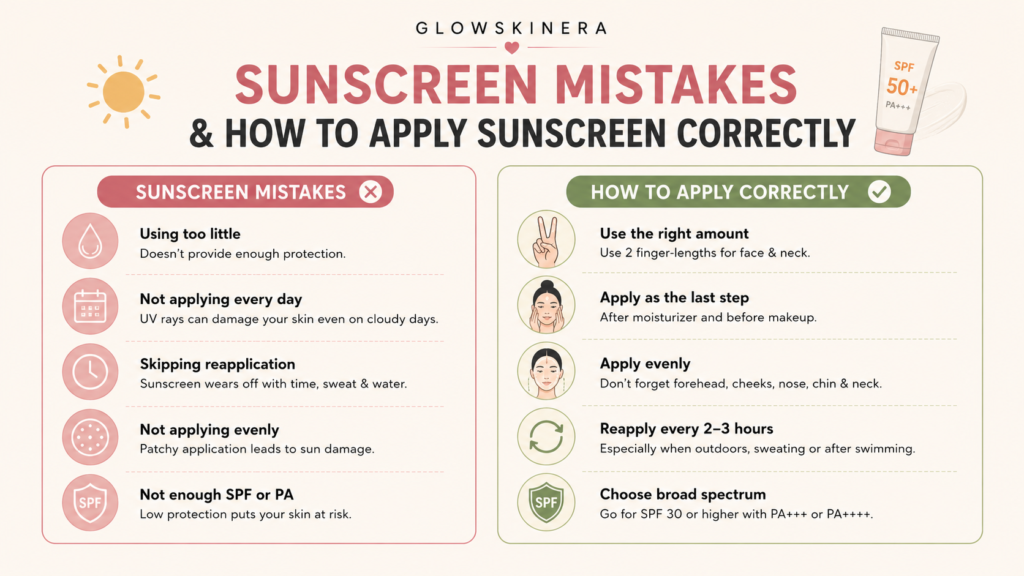
This is the single most widespread sunscreen mistake – and the one with the biggest actual impact on your protection.
The SPF number on your bottle – 30, 50, whatever it says – is calculated in a lab using 2mg of product per square centimetre of skin. That is approximately a full teaspoon for your face and neck, or a generous nickel-sized amount that most people look at and think is far too much.
Most people apply about 25–50% of the required amount. At that level, SPF 50 behaves closer to SPF 10 in real conditions. You are not getting the protection you paid for.
The fix: Use a full quarter to half teaspoon for your face alone. It should feel like a lot. If your skin absorbs it instantly without any trace, you almost certainly did not use enough.
Sunscreen Mistake 2 – You Are Applying It Too Late
You finish your moisturiser, get dressed, make coffee, do your hair, and then apply sunscreen right before you leave.
That is a sunscreen mistake that eliminates a meaningful chunk of your protection for the first 15–20 minutes of UV exposure.
Chemical sunscreens (those with ingredients like avobenzone, octinoxate, or oxybenzone) need time to absorb and undergo a chemical reaction with your skin before they can filter UV rays. Applied right before you walk outside, they have not activated yet.
The fix: Apply sunscreen as the last step of your skincare routine – before makeup, before getting dressed – and give it 15–20 minutes before UV exposure. If you use a physical/mineral sunscreen (zinc oxide or titanium dioxide), it works immediately on contact, making it a better option for people who are always rushing.
Sunscreen Mistake 3 – You Are Skipping Reapplication
One morning application does not protect you all day. This is one of the most misunderstood sunscreen mistakes in daily skincare.
SPF degrades with UV exposure, sweat, oil production, and touch. After about 2 hours of direct exposure, your protection has degraded significantly – regardless of the SPF number. SPF 50 does not last longer than SPF 30. It filters more UV initially, but both break down at the same rate.
The fix: Reapply every 2 hours during outdoor exposure. On regular office days with minimal sun, one solid morning application is typically adequate. But if you are outside – commuting, walking, sitting near windows – reapplication matters.
For easy reapplication over makeup, setting spray SPFs or SPF powder formulas make this completely doable without destroying your look.
Sunscreen Mistake 4 – You Are Rubbing It In Too Aggressively
Most people rub sunscreen in the same way they apply a body lotion – vigorous circular rubbing until it disappears completely.
With physical sunscreens, especially aggressive rubbing, displaces the product unevenly. You end up with thick coverage in some areas and barely any in others, which defeats the whole purpose of how to apply sunscreen correctly.
The fix: Apply sunscreen in gentle patting or pressing motions. Dot it across your forehead, cheeks, nose, and chin first, then press and blend outward. Gentle and even always beats fast and aggressive.
Sunscreen Mistake 5 – You Are Missing Key Areas Consistently
Most people apply sunscreen to the middle of their face and call it done. The areas that get missed most consistently – and get the most UV damage as a result:
- Ears and the hairline
- Upper lip and area around the mouth
- Eyelids and under-eye area
- Neck and décolletage
- Hands (one of the first places age spots appear)
- The back of the neck
These are not small omissions. The neck and décolletage in particular are the areas where the visible age gap between “skincare effort” and “UV neglect” shows up most brutally over time.
The fix: Make your sunscreen application deliberate. Take 60 extra seconds to cover your neck, ears, and hairline edge. Apply a dedicated eye-area SPF if your main sunscreen irritates that zone.
Sunscreen Mistake 6 – You Think Makeup With SPF Is Enough
Foundation SPF 15. BB cream SPF 20. Tinted moisturiser SPF 30. None of these is a replacement for dedicated sunscreen – and relying on them is one of the most common sunscreen mistakes in a beauty routine.
The same problem from Mistake 1 applies here: the SPF in makeup is tested at a much higher application weight than anyone actually uses. You would need to apply roughly 7–10 times your normal foundation amount to get the labelled SPF number in real life.
Makeup SPF is a bonus, not a foundation. It provides some extra coverage when layered over a dedicated sunscreen – that is all.
The fix: Always apply a dedicated SPF underneath your makeup. Your SPF does the protection work. Your makeup SPF is a secondary buffer only.
Sunscreen Mistake 7 – You Are Applying Sunscreen Under Active Skincare Ingredients
Vitamin C, retinol, and AHA/BHA acids do not belong under sunscreen in your morning routine.
Retinol and AHAs increase your skin’s photosensitivity dramatically – applying them in the morning and then going out into UV exposure is one of the most damaging sunscreen mistakes you can make with active ingredients. You are sensitising your skin and then sending it directly into the thing it is now most vulnerable to.
The fix: Retinol and AHAs are evening-only ingredients. Full stop. In the morning, your routine should be: gentle cleanser → antioxidant serum (vitamin C or niacinamide) → moisturiser → sunscreen. Nothing that increases photosensitivity ever goes on in the morning.
–Related: Skincare Ingredients Not to Mix – 6 Deadly Combos That Wreck Your Skin – the complete guide to what goes together and what never should.
Sunscreen Mistake 8 – You Are Using an Expired or Degraded Sunscreen
Sunscreen has a shelf life – and using one past its expiry is not just ineffective, it can actively irritate your skin.
UV filters break down over time, especially once a bottle has been opened and exposed to air, light, and heat. Keeping your sunscreen in a hot bathroom or car accelerates this degradation significantly.
If your sunscreen has separated, changed colour, developed a different smell, or simply been sitting open for more than 12 months, it is no longer doing what the label says.
The fix: Check the PAO symbol (the open jar icon) on your bottle — it tells you how many months the product is effective after opening. Store sunscreen in a cool, dry place away from direct light. Replace it on schedule, not when it runs out.
How to Apply Sunscreen Correctly – The Method That Actually Works {#how-to-apply}
The Correct Way to Apply Sunscreen for Full Protection
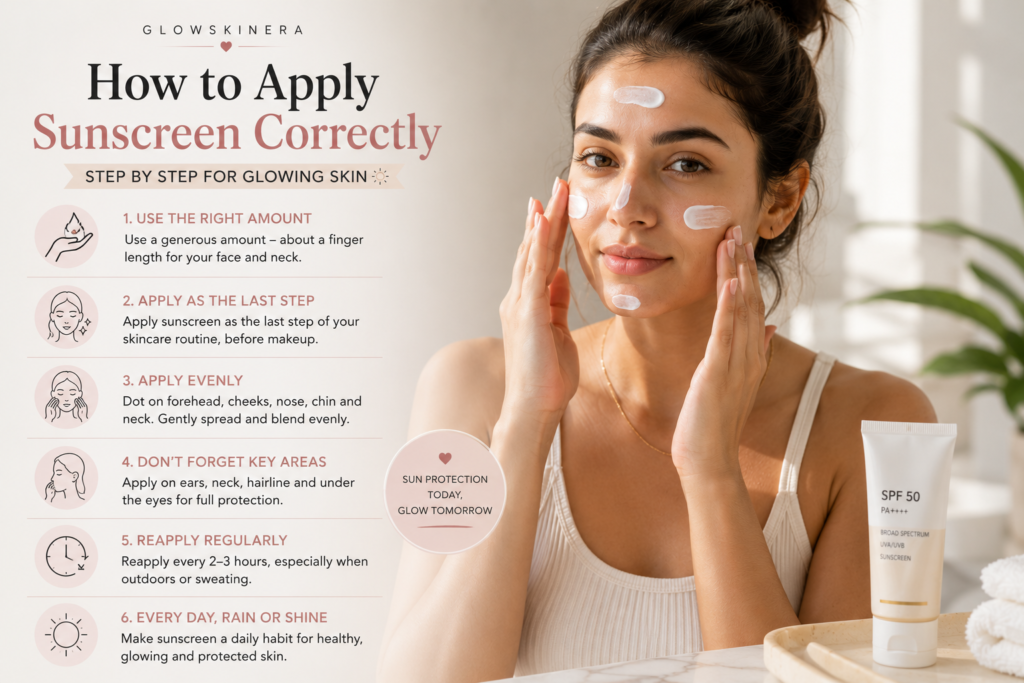
Knowing the sunscreen mistakes is half the battle. Here is exactly how to apply sunscreen correctly so every step builds on the last:
Step 1 – Finish your full morning skincare routine first: Cleanser → vitamin C or niacinamide serum → moisturiser. Let each layer absorb properly before the next.
Step 2 – Wait 2 minutes after moisturiser. Applying sunscreen onto wet or freshly-applied moisturiser dilutes it and affects how evenly it spreads.
Step 3 – Dispense a full quarter teaspoon. Dot it in five points: forehead, both cheeks, nose, chin. This ensures even starting distribution.
Step 4 – Press and blend outward gently. No rubbing. Press the product into skin with fingertips or the flat of your hand, working outward from the centre. Include jaw, ears, neck, and décolletage.
Step 5 – Wait 15–20 minutes before makeup or going outside. This is non-negotiable for chemical sunscreens. Use this time to get dressed, make your coffee, or do your hair.
Best Sunscreens That Avoid Every Common Mistake {#best-products}
Recommended Sunscreens for Every Skin Type
Every product here is chosen specifically because it makes correct application easier – the right texture, the right finish, the right formula for beginners who want to build a consistent habit.
| Product | SPF | Skin Type | Why It Is Recommended |
|---|---|---|---|
| La Roche-Posay Anthelios UVMune 400 | SPF 50+ | All types | Exceptional broad-spectrum coverage, lightweight, fragrance-free |
| Neutrogena Ultra Sheer Dry-Touch SPF 50 | SPF 50 | Oily, combination | Matte finish, absorbs fast, non-greasy – easy to apply the right amount |
| CeraVe AM Facial Moisturising Lotion SPF 30 | SPF 30 | Dry, normal | Contains ceramides – moisturiser and SPF in one, reduces layering steps |
| The Ordinary Mineral UV Filters SPF 30 | SPF 30 | Sensitive | Mineral formula, works immediately on contact, no activation time needed |
| Altruist Broad Spectrum SPF 50 | SPF 50 | All types | Budget-friendly, dermatologist-developed, easy to use generously without guilt |
Why La Roche-Posay specifically for the top pick?
La Roche-Posay Anthelios is one of the most clinically studied sunscreens available without a prescription. Its UVMune 400 filter covers ultra-long UVA rays that most standard sunscreens do not reach. For anyone serious about preventing the UV damage behind ageing and pigmentation, this is the standard to work towards. You can read their clinical data on La Roche-Posay’s official research hub.
How Sunscreen Fits Into Your Full Morning Routine {#routine}
The Morning Routine That Avoids Every Sunscreen Mistake
☀️ Morning – every day, no exceptions:
- CeraVe Hydrating Cleanser – gentle start, no stripping
- The Ordinary Niacinamide 10% + Zinc 1% – antioxidant protection + barrier support
- The Ordinary Hyaluronic Acid 2% + B5 – hydration layer while skin is damp
- CeraVe AM Facial Moisturising Lotion SPF 30 or your chosen dedicated SPF
- Wait 15–20 minutes – then makeup if needed
What never goes in the morning routine:
- Retinol
- AHA exfoliants (glycolic, lactic acid)
- BHA exfoliants (salicylic acid)
- High-concentration Vitamin C on already-sensitised skin
These all increase photosensitivity and belong exclusively in your evening routine.
Related: The Correct Skincare Routine Order for Beginners – full AM and PM routine guide with every product in the right order.
FAQs About Sunscreen Mistakes and How to Apply Sunscreen Correctly
Q: What is the biggest sunscreen mistake most people make without realising?
Not using enough product. The SPF number on the label is tested at a specific quantity – about a quarter to half teaspoon for the face – and most people use less than half of that. At 50% of the required amount, your SPF 50 is performing closer to SPF 7. This single sunscreen mistake reduces protection more than almost any other factor.
Q: Does SPF in foundation count as sunscreen?
Not as a replacement. Makeup SPF is a useful secondary layer, but cannot do the job of a dedicated sunscreen on its own – you would need to apply 7–10 times the normal amount of foundation to get the labelled protection. Always apply a dedicated SPF underneath your makeup, and treat the makeup SPF as a bonus buffer only.
Q: How do I reapply sunscreen over makeup without ruining it?
Use an SPF setting spray or an SPF powder brush. Both are designed for reapplication over existing makeup and give you a meaningful top-up without disrupting your foundation. They are especially useful for midday reapplication during outdoor activities.
Q: Is SPF 30 or SPF 50 better for daily use?
SPF 50 is always better than SPF 30 – it filters about 98% of UVB rays versus 97% for SPF 30. The difference sounds small, but it accumulates significantly with daily exposure over the years. For a daily city routine, SPF 30 applied correctly is adequate. For outdoor time, SPF 50 is the correct choice.
Q: Can I skip sunscreen on cloudy days?
No. Up to 80% of UV rays penetrate cloud cover. Overcast days provide almost no meaningful UV protection. Sunscreen mistakes are not just about sunny-day skipping – overcast skipping is equally damaging over time.
Q: Do I need sunscreen indoors?
For UVB (burning rays), indoor glass provides good protection. But UVA rays (the ones behind skin ageing and pigmentation) penetrate glass easily. If you sit near windows for extended periods, applying sunscreen indoors genuinely matters for long-term skin health.
Q: How do I know if my sunscreen has degraded?
Check the PAO symbol (open jar icon with a number) on the packaging – it tells you how many months after opening the product remains effective. Signs of degradation include separated formula, changed colour or smell, and watery texture. When in doubt, replace it. Using degraded sunscreen is one of the most overlooked sunscreen mistakes in a daily routine.
Q: Is mineral or chemical sunscreen better for beginners?
Both work when applied correctly – the best sunscreen is the one you will actually use enough of consistently. Mineral sunscreens (zinc oxide, titanium dioxide) work immediately on application and are better for sensitive or reactive skin. Chemical sunscreens tend to have lighter textures that are easier to layer under makeup. For beginners building the habit, texture preference matters – choose the one you enjoy wearing daily.
The Bottom Line on Sunscreen Mistakes
The most powerful anti-ageing, anti-pigmentation, skin-protecting step in any skincare routine is not your vitamin C or your retinol. It is a full, correctly applied layer of sunscreen every single morning – and avoiding the sunscreen mistakes that silently neutralise it.
Eight mistakes. Every single one is fixable today.
Get the amount right. Apply it in the right order. Give it time to work. Reapply when it counts. Cover the areas you have been skipping.
That is not a complicated routine change. That is five minutes of intention in the morning that protects every other product you are using and every skin goal you are working toward.
Your SPF is only as good as how you use it. Now you know exactly how.
Read next: Gentle Exfoliation Guide – 7 Brutal Mistakes That Are Wrecking Your Skin | Skincare Ingredients Not to Mix
Which sunscreen mistake surprised you most? Drop it in the comments – the most common answer we get is “I had no idea I was not using enough.”
📌 Pin this to your skincare-mistakes board – your future skin will be genuinely grateful.

Leave a Reply