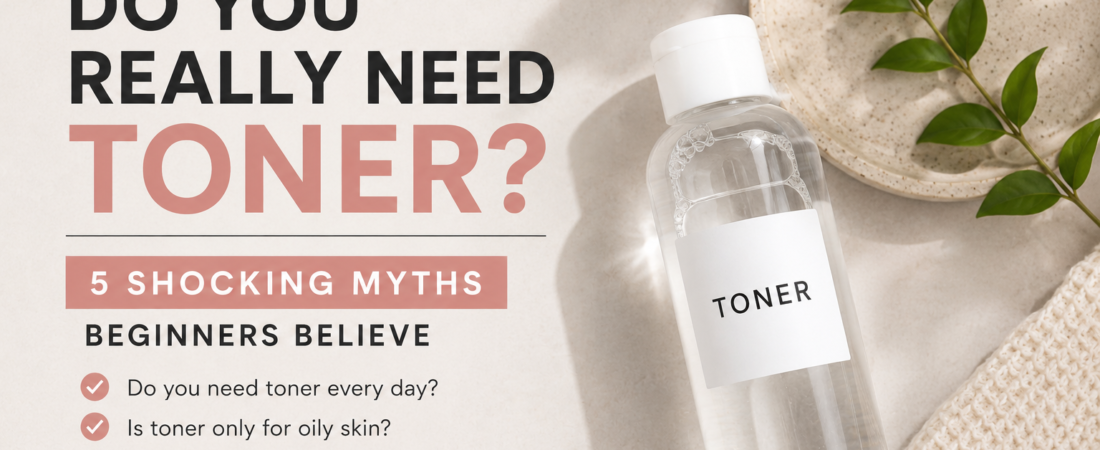
Do you need toner in your skincare routine – or is it just one of those products that got popular because it looked good in a skincare haul?
This is one of the most googled skincare questions for a reason. Walk into any beauty store, and forty toners are staring back at you. Open any skincare video, and someone is patting a cotton pad across their face. It looks essential.
But here is the truth most beginners never hear: toner is the most misunderstood step in skincare. For some people, it is genuinely useful. For others, it is completely unnecessary – and for a surprising number of people, the wrong toner is actively making their skin worse.
So do you need toner? Let us actually answer that – with no filler, no brand loyalty, and no vague “it depends” that leaves you more confused than when you started.
📌 Save this post – this is the toner explainer you will want every time someone tells you your routine is incomplete without one.
What Does Toner Actually Do?
Understanding Toner Before Deciding If You Need It
Toner was originally created in an era when cleansers were genuinely harsh – soap-based, high-pH formulas that left skin feeling stripped and off-balance. Toner came after cleansing to restore the skin’s natural pH so the next products could actually absorb and work properly.
That was the original job. And it made sense – for the cleansers of the 1980s.
Modern cleansers are a completely different product. Most quality cleansers today are already pH-balanced, gentle, and do not strip the skin the way old formulas did. The “restore pH after cleansing” argument for toner is largely outdated — your cleanser is not destroying your pH the way it used to.
So do you need toner for that original purpose? For most people using a modern gentle cleanser – no.
But toner has evolved. Today there are three distinct categories of toner, and they do very different things:
Hydrating toners – add a layer of moisture and prep skin to absorb serums better. Think of them as a first layer of hydration, not a pH fixer.
Exfoliating toners – contain AHA or BHA acids and are essentially a leave-on chemical exfoliant in toner form. These are active skincare products, not prep steps.
Astringent toners – the old-school alcohol-heavy kind. These tighten pores temporarily and strip oil. They are the most commonly recommended type for oily skin, and ironically the most damaging.
Knowing which category you are dealing with is the first step to answering whether do you need toner applies to you personally.
Do You Need Toner? The Honest Answer
The Real Answer to “Do You Need Toner” Based on Your Skin Type
Here is the honest, skin-type-specific answer to the question you need toner:
If you have dry or sensitive skin: You probably do not need toner. A good cleanser followed directly by a hydrating serum and moisturiser covers everything a hydrating toner would add – without the extra step and extra cost. If your skin already reacts to products easily, adding another layer of liquid increases that risk.
If you have oily or acne-prone skin: You might benefit from a toner – but only the right kind. An exfoliating toner with salicylic acid, used 2–3 times per week, does useful work inside your pores. An astringent toner with alcohol will strip your skin, trigger more oil production as a rebound response, and make your oiliness worse over time.
If you have combination skin: A hydrating toner on dry areas and a targeted exfoliating toner on oily areas can be useful. But you can achieve the same result with a well-chosen serum and skip the toner entirely.
If you are a beginner: Focus on the four non-negotiable steps first – cleanser, serum, moisturiser, SPF. Add toner only after your core routine is consistent and working. Piling on extra steps before your basics are solid is one of the most common beginner skincare mistakes.
Related: The Correct Skincare Routine Order for Beginners – get your foundation right before adding anything extra.
The bottom line on do you need toner: it is optional for most people, genuinely useful for some, and quietly harmful for others. The category matters more than the product.
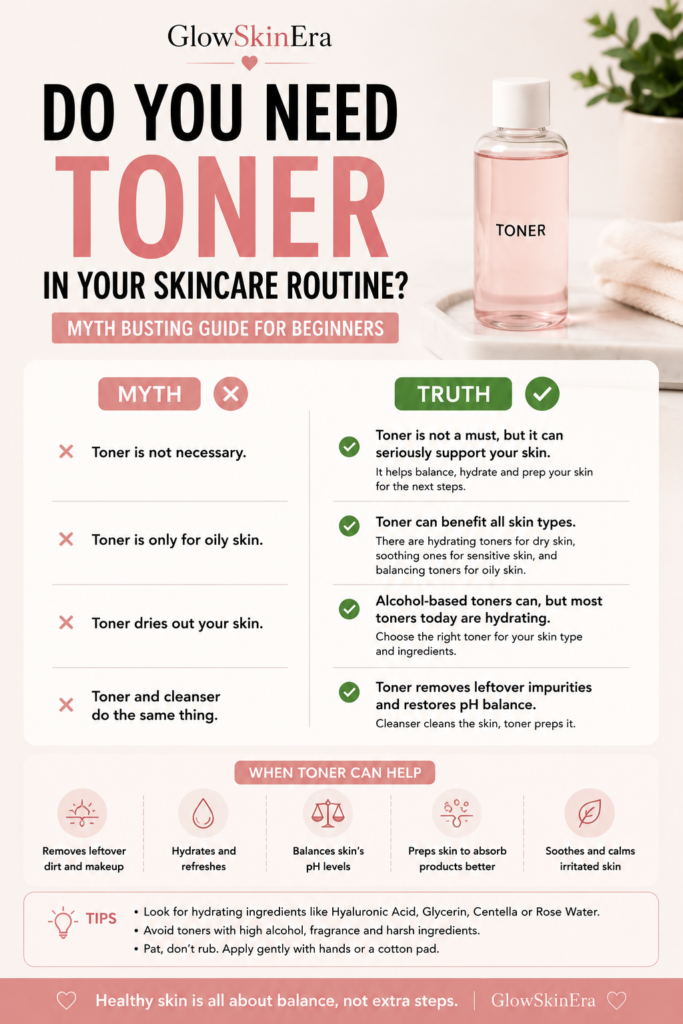
5 Toner Myths Beginners Believe (And the Truth Behind Each One)
Toner Myth 1 – “Your Routine Is Incomplete Without Toner”
This is probably the most widespread toner myth – and it comes directly from skincare marketing, not from dermatology.
No dermatologist or skincare scientist has ever defined a “complete” routine as one that requires toner. The non-negotiables in a skincare routine are: a gentle cleanser, an active serum (if needed), a moisturiser, and SPF. That is it. Those four steps cover the fundamentals of every skin goal – hydration, protection, treatment, and repair.
Do you need toner to have a complete routine? No. A routine without toner is not missing anything. A routine without SPF is.
Toner Myth 2 – “Toner Closes Your Pores”
You will see this claim on countless toner bottles and in just as many skincare videos. Cold toner, astringent toner, pH-balancing toner – all supposedly “closing” your pores for a refined, smooth finish.
Pores do not open and close. They are not doors. They are follicle openings in your skin with fixed dimensions determined by genetics and sebum production.
What toner can do temporarily is cause mild skin contraction through alcohol or cold temperature, which makes pores appear smaller for a short time. But the effect is cosmetic and temporary – thirty minutes later your skin looks the same as before.
If you want genuinely smaller-looking pores over time, do you need toner for that? No. You need consistent use of niacinamide and salicylic acid – ingredients that reduce sebum production and keep pores clear so they look smaller.
The Ordinary Niacinamide 10% + Zinc 1% is one of the most effective and affordable products for this exact concern – and it is a serum, not a toner.
Toner Myth 3 – “Toner Removes the Residue Your Cleanser Leaves Behind”
This myth assumes your cleanser is not doing its job – and if you are using a quality gentle cleanser, it almost certainly is.
The idea that toner on a cotton pad picks up “leftover dirt and oil” after cleansing became popular because – yes, if you swipe a cotton pad soaked in toner across your face after cleansing, it will often look brown or grey.
But that colour is not leftover dirt. It is a combination of dead skin cells your cleanser loosened but the cotton pad picked up, tap water mineral residue, and in some cases the pigment from the cotton pad itself reacting with the toner formula.
Do you need toner to complete your cleanse? No. A proper double cleanse – an oil-based cleanser first to dissolve SPF and makeup, followed by CeraVe Hydrating Cleanser or Cetaphil Gentle Skin Cleanser – leaves your skin genuinely clean. No follow-up required.
According to the American Academy of Dermatology’s skincare guidance, a gentle, properly rinsed cleanser is sufficient for removing surface impurities – additional stripping steps are not recommended for most skin types.
Toner Myth 4 – “Astringent Toner Is the Best Thing for Oily Skin”
This one causes more damage than almost any other toner myth – because it targets the people who are most actively looking for help with their skin.
Alcohol-based astringent toners do reduce surface oil in the short term. They feel effective. Your skin feels tight and mattified. The problem is what happens after.
When skin is stripped of its natural oils consistently, it responds by producing more oil to compensate. You end up oilier than before, with a compromised barrier that is simultaneously dehydrated and over-producing sebum. Your skin becomes both oily and sensitive — a combination that is significantly harder to manage than the original oiliness you were trying to fix.
Do you need toner if you have oily skin? Only if it is a salicylic acid-based toner used at the right frequency. Paula’s Choice 2% BHA Liquid Exfoliant is a far better choice for oily skin than any astringent – it clears pores from the inside without stripping the surface.
Related: Gentle Exfoliation Guide – 7 Brutal Mistakes That Are Wrecking Your Skin – the full guide to exfoliating safely if this is your skin concern.
Toner Myth 5 – “You Need to Use Toner Twice a Day, Every Day”
If a toner contains active ingredients – acids, retinoids, high-concentration niacinamide – using it twice daily, every day, is almost certainly too much.
Even hydrating toners used twice daily on skin that does not need extra hydration can disrupt the skin’s surface microbiome over time. The skin has its own moisture regulation system. Constantly adding liquid layers on top interferes with that.
Do you need toner twice a day? Unless a dermatologist has specifically recommended it for a diagnosed skin condition, no. Once in the evening, 2–3 times per week for active toners, is the appropriate starting point for most people.
[do you need toner every day – toner myths for beginners — GlowSkinEra](alt: do you need toner every day skincare myth GlowSkinEra)
When Toner Is Actually Worth Using
The Cases Where “Do You Need Toner” Has a Yes Answer
There are situations where do you need toner genuinely has a yes answer – here is when:
You are dealing with persistent blackheads or clogged pores – a salicylic acid toner used 2–3 times per week is a genuinely effective treatment step. It is not extra; it is targeted.
You live in a very dry climate or travel frequently – a hydrating toner like The Ordinary Hyaluronic Acid 2% + B5 used as a first layer can meaningfully boost your skin’s moisture retention in environments where humidity is low.
You have been using a rich oil-based cleanser – a gentle hydrating toner after oil cleansing can help balance the skin feel and prep for your serum more effectively.
You enjoy the ritual — skincare is also about how it makes you feel, not just clinical outcomes. If a hydrating toner feels good on your skin, adds to your routine enjoyment, and is not causing any irritation, that is a completely valid reason to use it.
The Toners Worth Buying (And What to Skip)
Do You Need Toner? Only If It Is One of These
If, after all of this, you decide you need toner, and the answer is yes for your specific situation, here are the only options worth spending money on:
| Product | Type | Best For | How Often |
|---|---|---|---|
| Paula’s Choice 2% BHA Liquid Exfoliant | Exfoliating BHA toner | Oily, acne-prone, blackheads | 2–3x per week, evenings only |
| The Ordinary Glycolic Acid 7% Toning Solution | Exfoliating AHA toner | Dull, uneven texture | 1–2x per week, evenings only |
| Medicube Zero Pore Toner Pads | Gentle AHA/BHA combo | Beginners, combination skin | 2x per week |
| The Ordinary Hyaluronic Acid 2% + B5 | Hydrating essence/toner | Dry skin, low-humidity environments | Daily, morning or evening |
What to skip entirely:
Any toner with alcohol listed in the first five ingredients. Any toner marketed as “pore-minimising” through astringency. Any toner that tingles, burns, or feels cold as its primary effect.
Related: Skincare Ingredients Not to Mix – 6 Deadly Combos That Wreck Your Skin – if your toner contains actives, this guide tells you what not to layer on top of it.
How to Use Toner Correctly If You Decide You Need It
The Right Way to Use Toner Once You Know Do You Need Toner
Step 1: Cleanse with CeraVe Hydrating Cleanser or Cetaphil – let skin dry for 30 seconds.
Step 2: Apply toner by pressing it gently into skin with clean hands, or with a cotton pad using light downward strokes – never scrubbing.
Step 3: Wait 60–90 seconds for the toner to absorb fully.
Step 4: Apply your serum – The Ordinary Niacinamide 10% + Zinc 1% or The Ordinary Hyaluronic Acid 2% + B5.
Step 5: Seal with CeraVe Moisturising Cream.
Step 6: SPF in the morning, always.
One thing worth noting: if your toner contains exfoliating acids, wait 20 minutes before applying any serum on top. Actives need time to work at the correct pH before you layer anything over them.
FAQs – Do You Need Toner?
Q: Do you need toner if you already use a serum?
For most people, no. If your serum contains hydrating ingredients like hyaluronic acid or niacinamide, it is already doing what a hydrating toner would do – and doing it more efficiently at a higher concentration. Toner becomes redundant unless it is serving a specific purpose that your serum does not cover.
Q: Do you need toner as a beginner?
Not to start. Build your four core steps first – cleanser, serum, moisturiser, SPF – and get those consistent for at least six weeks. Toner is something to consider adding later if a specific skin concern is not being addressed by your existing routine.
Q: Do you need toner if your skin is already clear?
If your skin is clear, calm, and responding well to your routine – no. Clear skin is the goal, not the starting point for adding more products. Do not add steps to a routine that is already working.
Q: Is The Ordinary Glycolic Acid 7% a toner or an exfoliant?
Both. It is sold as a toning solution, but it functions as a chemical exfoliant. If you use it, treat it like an exfoliant – 1–2 times per week at night, not as a daily toner. And never layer it with other acids or retinol.
Q: Do you need toner if you have dry skin?
A hydrating toner can add a beneficial extra layer of moisture for dry skin – but it is not essential. The Ordinary Hyaluronic Acid 2% + B5 applied to damp skin, sealed with CeraVe Moisturising Cream, will deliver more hydration than most toners at a fraction of the cost.
Q: Can toner replace a serum?
No. Toners are generally too low in active concentration to replace what a well-formulated serum delivers. They work as a prep layer or a light active step – not as a replacement for targeted treatment.
Q: Do you need toner if your cleanser already has salicylic acid?
Be careful here. If your cleanser already contains salicylic acid, adding a salicylic acid toner on top is double exfoliation in one routine step. This is an exfoliating mistake that compounds barrier damage. Pick one or the other – not both.
The Bottom Line – Do You Need Toner?
Do you need toner to have great skin? No.
Do some people benefit from the right toner used correctly? Absolutely.
The difference between those two answers is the entire point of this guide. Toner is not magic and it is not essential – it is an optional step that does specific things well when chosen correctly and used appropriately. Most of the reasons people think they need toner are myths built by marketing, not by skin science.
Get your core routine right. Understand your actual skin concerns. Then decide whether a toner adds anything real to what you are already doing.
That is how you shop for skincare like someone who knows what they are doing – not like someone who just wants a full shelf.
Read next: The Correct Skincare Routine Order for Beginners | Gentle Exfoliation Guide – 7 Brutal Mistakes That Are Wrecking Your Skin
Do you use toner in your routine? Drop your skin type and which one in the comments – we read every single one.
📌 Pin this to your skincare board – finally settle the toner debate for good.

Leave a Reply