Niacinamide and vitamin C together – two of the most googled ingredient questions in skincare, and honestly, one of the most confusing.
Half the internet tells you to never mix them. The other half says they are completely safe together. And you are stuck somewhere in the middle, staring at your serums, wondering if you are about to wreck your skin or waste your money keeping them apart.
Here is the truth: the original warning was based on real chemistry – but it has been misunderstood, overstated, and repeated so many times online that it has taken on a life of its own.
This post breaks down exactly what happens when you use niacinamide and vitamin C together, what the science actually says, who should be careful, and how to build a routine that gets the best out of both ingredients – without the confusion.
📌 Save this post before you scroll – this is the niacinamide and vitamin C answer you have been looking for.
What the Original Warning About Niacinamide and Vitamin C Together Was
Where the “Never Mix Them” Myth Came From
The concern about using niacinamide and vitamin C together comes from real chemistry – and understanding it is what separates good skincare advice from bad.
When niacinamide (a form of vitamin B3) and ascorbic acid (the active form of vitamin C) are combined, they can theoretically react to form a compound called niacin.
Niacin is responsible for something called a “niacin flush” – a temporary redness and warmth on the skin. There was also a secondary concern that this reaction could lead to a yellowish discolouration of the skin over time.
This is where the original “do not mix niacinamide and vitamin C together” advice came from.
And it was not completely wrong – it just described a reaction that happens under very specific conditions that almost never occur in real skincare use.
What Modern Research Actually Says About Niacinamide and Vitamin C Together {#what-research-says}
The Science Has Moved On – Here Is What It Shows
The niacinamide-to-niacin conversion requires two things that typical skincare products do not provide: sustained high temperatures and high concentrations of both ingredients in direct contact over a prolonged period.
At normal skin temperature, and at the concentrations used in standard skincare formulations, the conversion rate is negligible. A study published in the International Journal of Cosmetic Science found that the conversion of niacinamide to niacin in properly formulated cosmetic products at room temperature is so minimal that it is considered clinically irrelevant.
The yellowish tint concern was similarly linked to oxidised vitamin C – a formulation stability problem, not a skin reaction from the combination itself.
Modern cosmetic chemists have also pointed out that well-stabilised vitamin C derivatives (like ascorbyl glucoside or ethyl ascorbic acid) do not trigger this reaction at all, and most current vitamin C products use these more stable forms rather than pure L-ascorbic acid.

The conclusion from current dermatological research: using niacinamide and vitamin C together is safe for the vast majority of people when both products are well-formulated and used correctly.
So Can You Use Niacinamide and Vitamin C Together? {#can-you-use-them-together}
The Honest, Direct Answer
Yes – for most people, using niacinamide and vitamin C together is not only safe but genuinely beneficial.
Here is why this combination actually makes sense:
Vitamin C brightens skin, fades dark spots and hyperpigmentation, and provides antioxidant protection against UV and pollution damage. It works best at a low pH (around 2.5–3.5), which means it is inherently acidic.
Niacinamide strengthens the skin barrier, reduces inflammation and redness, minimises the appearance of pores, and regulates oil production. It works at a higher pH (around 5–7).
When you use them together, niacinamide’s anti-inflammatory properties can actually help buffer some of the irritation that high-strength vitamin C causes — especially for people with sensitive skin. And vitamin C’s brightening action works alongside niacinamide’s pore-minimising and texture-smoothing effects to give you a more comprehensive result than either ingredient delivers alone.
The real question is not whether you can use niacinamide and vitamin C together – it is how you use them to get the best result.
Related: Skincare Ingredients Not to six – 6 Deadly Combos That Wreck Your Skin – niacinamide and vitamin C are fine together; these combinations are the ones that actually cause damage.
Who Should Separate Niacinamide and Vitamin C Together and Who Can Combine Them {#who-should-separate}
This Is the Part Most Articles Get Wrong
Not everyone’s answer is the same. Here is how to know where you fall:
You can use niacinamide and vitamin C together in the same routine if:
- You have normal, oily, or combination skin with no history of flushing
- You are using a stabilised vitamin C formula (ascorbyl glucoside, ethyl ascorbic acid, or well-formulated L-ascorbic acid)
- The concentration of your vitamin C is 10–15% or lower
- Your skin has been tolerating both ingredients individually without issues
You should separate niacinamide and vitamin C (use one in AM, one in PM) if:
- You have sensitive or reactive skin that flushes easily
- You are using a very high concentration of vitamin C (20%+)
- You have experienced redness or warmth when using them together before
- You are a complete beginner to active ingredients and want to introduce them one at a time
For sensitive skin, separating them is a practical precaution – not because the combination is dangerous, but because it reduces variables and makes it easier to identify what your skin is and is not tolerating as you build your routine.
Related: How to Build the Perfect Skincare Routine for Your Skin Type (Beginner-Friendly Guide) – find out which actives are right for your specific skin before layering anything.
How to Use Niacinamide and Vitamin C Together the Right Way {#how-to-use-together}
The Two Approaches – Pick the One That Fits Your Skin
Approach 1 – Use Them Together in the Morning (for normal/oily/combination skin)
This is the most efficient approach and works well for people whose skin is not particularly sensitive.
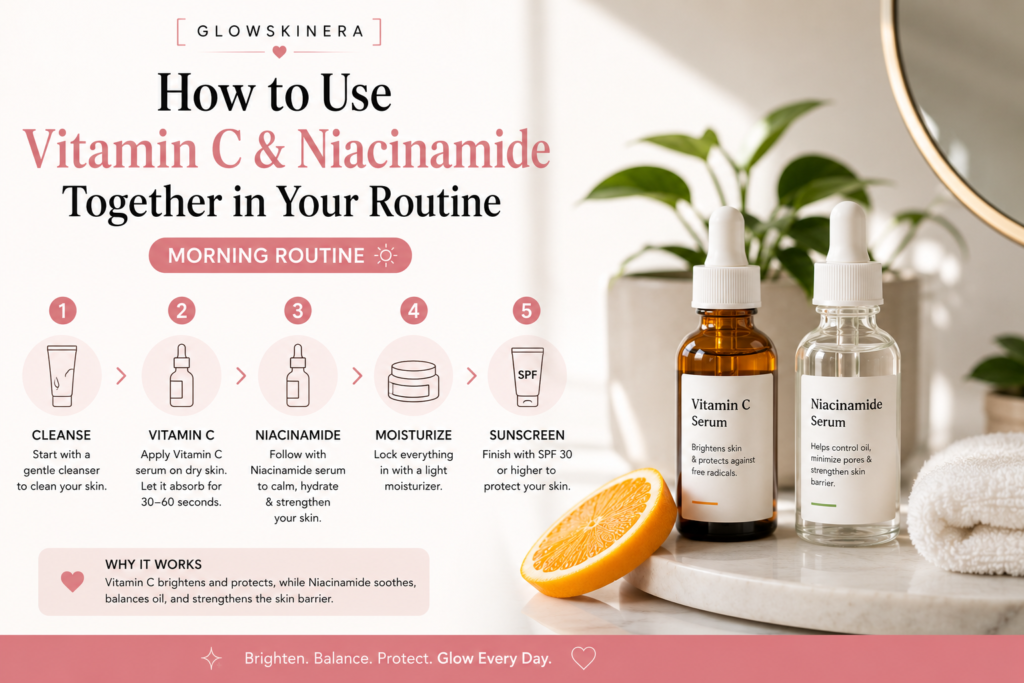
Apply vitamin C first – it needs direct contact with the skin to absorb properly. Wait 60–90 seconds. Then apply niacinamide. Follow with moisturiser and SPF.
The slight wait between them allows the vitamin C to begin absorbing at its optimal low pH before the niacinamide (which sits at a higher pH) is layered on top.
Approach 2 – Separate AM and PM (for sensitive skin)
Vitamin C in the morning, niacinamide in the evening. This eliminates any possibility of interaction, reduces the variable load on sensitive skin, and means each ingredient has its own dedicated session to absorb fully without competition.
Vitamin C in the morning pairs naturally with SPF for maximum antioxidant protection. Niacinamide in the evening pairs with hyaluronic acid and moisturiser for barrier repair and overnight recovery.
Both approaches deliver excellent results – the difference is in who is using them and what their skin responds to.
What Niacinamide and Vitamin C Together Actually Do for Your Skin {#what-each-does}
Why This Combination Is Worth Getting Right
When you use niacinamide and vitamin C together correctly, you are addressing multiple skin concerns simultaneously:
Vitamin C delivers:
- Brightening and fading of dark spots and post-acne marks
- Antioxidant protection against environmental damage
- Stimulation of collagen production
- A more even, luminous skin tone over time
Niacinamide delivers:
- Strengthening of the skin barrier (increases ceramide production)
- Reduction of pore appearance
- Oil regulation for oily and combination skin
- Anti-inflammatory action that calms redness and breakouts
Together, they cover:
Brightening + barrier strength + pore minimising + anti-inflammatory protection + antioxidant defence. That is a lot of ground covered by two affordable, beginner-friendly ingredients.
This is exactly why niacinamide and vitamin C together – done correctly – is one of the smartest combinations in a beginner skincare routine.
Related: The Correct Skincare Routine Order for Beginners – the complete layering guide so every product in your routine lands in the right order.
Best Products to Use for Niacinamide and Vitamin C Together {#best-products}
Affordable, Beginner-Safe, and Proven to Work
Every product here is chosen specifically because it is formulated in a way that makes niacinamide and vitamin C together work effectively – not just marketing claims, but actual formulation quality at an accessible price point.
| Product | Ingredient | Why It Works for This Combination |
|---|---|---|
| TruSkin Vitamin C Serum | Vitamin C (stabilised) | Well-formulated, stable vitamin C at a beginner-friendly strength – less likely to cause issues when layered with niacinamide |
| The Ordinary Niacinamide 10% + Zinc 1% | Niacinamide | The most widely recommended niacinamide product globally – straightforward formula, no unnecessary additives |
| The Ordinary Hyaluronic Acid 2% + B5 | Hydration support | Bridges the gap between actives and moisturiser, supports barrier health when using multiple ingredients |
| CeraVe Moisturising Cream | Barrier repair | Seals everything in with ceramides – essential after any active ingredient use |
| CeraVe Hydrating Cleanser | Pre-routine cleanse | pH-balanced, non-stripping – keeps skin stable before applying actives |
Why TruSkin Vitamin C specifically?
Pure L-ascorbic acid at very high concentrations is the most likely form of vitamin C to cause pH-related issues when layered with niacinamide. TruSkin’s stabilised formula uses a combination of vitamin C, vitamin E, and hyaluronic acid that is both effective and better tolerated — making it a smart choice for anyone specifically wanting to use niacinamide and vitamin C together without complications.
Full Routine Using Niacinamide and Vitamin C Together {#routine}
The Complete AM and PM Routine (Both Approaches)
☀️ Morning – Combined Approach (normal/oily/combo skin):
- CeraVe Hydrating Cleanser
- TruSkin Vitamin C Serum – apply first, wait 60–90 seconds
- The Ordinary Niacinamide 10% + Zinc 1% – layer on top
- The Ordinary Hyaluronic Acid 2% + B5
- CeraVe Moisturising Cream
- SPF 30+ – always last, always non-negotiable
☀️ Morning – Separated Approach (sensitive skin, Vitamin C only):
- CeraVe Hydrating Cleanser
- TruSkin Vitamin C Serum
- The Ordinary Hyaluronic Acid 2% + B5
- CeraVe Moisturising Cream
- SPF 30+
🌙 Evening — Separated Approach (Niacinamide session):
- CeraVe Hydrating Cleanser
- The Ordinary Niacinamide 10% + Zinc 1%
- The Ordinary Hyaluronic Acid 2% + B5
- CeraVe Moisturising Cream
This is what using niacinamide and vitamin C together – or thoughtfully apart – looks like as a complete, functional routine. Not overwhelming. Not complicated. Just effective.
FAQs About Using Niacinamide and Vitamin C Together {#faqs}
Q: Does using niacinamide and vitamin C together really cause skin flushing?
For most people using modern, well-formulated products at standard concentrations, no. The flushing reaction requires conditions that typical skincare products do not create. If you do experience warmth or redness when using them together, separate them by time of day, and it resolves immediately.
Q: Which goes on first – niacinamide or vitamin C?
Vitamin C always goes first. It needs direct skin contact to absorb at its optimal pH. Apply it, wait 60–90 seconds, then layer niacinamide on top. This order matters more than the time gap between them.
Q: Can I use niacinamide and vitamin C together every day?
Yes – both niacinamide and vitamin C are non-exfoliating ingredients that are safe for daily use. Unlike AHAs, BHAs, or retinol, there is no sensitivity build-up period or frequency limit for this combination.
Q: Will niacinamide cancel out my vitamin C?
No. This is an extension of the original myth. Niacinamide does not neutralise or deactivate vitamin C. At worst, if both are poorly formulated and used in very high concentrations together, you might see minor pH interference – but this does not “cancel” either ingredient’s effect.
Q: I have been using niacinamide and vitamin C together for weeks with no issues. Should I stop?
Absolutely not. If your skin is tolerating the combination and you are seeing good results, carry on. The fact that your skin is responding well is exactly the outcome this combination is supposed to produce.
Q: Is The Ordinary Niacinamide safe to use with vitamin C from a different brand?
Yes. The interaction concern (when it applies) is about the chemistry of the ingredients themselves, not the brands. The Ordinary Niacinamide 10% + Zinc 1% is one of the safest, most straightforward formulas available and pairs well with vitamin C products from any brand.
Q: Can beginners start with niacinamide and vitamin C together from day one?
If you have completely untested skin with no active concerns, introducing them one at a time first is wise – not because they are dangerous together, but so you know how each one individually affects your skin before combining them. Start with niacinamide for two weeks, then introduce vitamin C. Once you know both are tolerated, using niacinamide and vitamin C together is absolutely fine.
Q: Does this combination help with dark spots specifically?
Yes – and this is actually one of the strongest use cases for using niacinamide and vitamin C together. Vitamin C directly inhibits melanin production (the pigment that causes dark spots), while niacinamide interrupts the transfer of melanin to skin cells. They target hyperpigmentation through two different mechanisms simultaneously, which is more effective than either ingredient working alone.
The Bottom Line on Using Niacinamide and Vitamin C Together
The old warning was not invented – it was based on real chemistry. But it described a reaction that almost never occurs in real skincare use, and it has been repeated so many times that it became accepted skincare gospel without anyone stopping to question it.
The reality: niacinamide and vitamin C together is one of the most effective beginner combinations in skincare. Brightening, barrier-strengthening, pore-minimising, anti-inflammatory, and antioxidant — all in two affordable, accessible products.
Use them together in the morning if your skin is not sensitive. Separate them if it is. Either way, both ingredients deserve a place in your routine.
Stop keeping them apart out of outdated fear. Your skin is missing out.
Read next: Skincare Ingredients Not to Mix — 6 Deadly Combos That Wreck Your Skin | The Correct Skincare Routine Order for Beginners
Have you been keeping niacinamide and vitamin C apart? Drop a comment – you will not be the only one.
📌 Pin this to your skincare-routine board – this is the answer half the internet gets wrong.

Leave a Reply