Damaged skin barrier symptoms are behind more “mystery skin problems” than most people ever realise – and if your skin has been acting up lately, this might be the most important thing you read all year.
Redness that will not calm down. Moisturiser that stings the second it touches your face. Breakouts are appearing in places that have never broken out before. Skin that feels dry again thirty minutes after you just moisturised it.
None of that is “bad skin.” All of that is a damaged skin barrier – and once you know what you are actually dealing with, fixing it is far simpler than you would expect.
This guide walks through every major damaged skin barrier symptom, explains exactly why each one happens, and tells you what your skin needs to repair itself. Every product recommended here is affordable, beginner-safe, and chosen because it genuinely works for this specific problem.
📌 Save this post now. Every time your skin starts acting up unexpectedly, this is the checklist you will want to come back to.
What Is the Skin Barrier and Why Does It Break Down
Before getting into the damaged skin barrier symptoms, it helps to understand what the barrier actually is – because it is not just marketing language.
Your skin barrier (the stratum corneum) is the outermost layer of your skin. Picture a brick wall: your skin cells are the bricks, and a mixture of ceramides, fatty acids, and natural oils is the mortar holding everything together. When that wall is intact, it keeps moisture locked in and keeps bacteria, pollution, and irritants locked out.
When it breaks down, that protective wall starts to crumble – and every single one of the damaged skin barrier symptoms below is a direct result of that crumbling happening.
The most common causes of a damaged skin barrier:
- Over-exfoliating with AHA, BHA acids, or physical scrubs
- Using too many active ingredients at once
- Mixing the wrong skincare ingredients together
- Harsh foaming cleansers that strip natural oils
- Skipping moisturiser consistently
- Cold weather, dry air, and UV damage
Related: Skincare Ingredients Not to Mix – 6 Deadly Combos That Wreck Your Skin – if layering mistakes caused your barrier damage, read this next.
The reassuring part: your skin barrier can fully repair itself. It just needs the right environment and the right ingredients to do it.
7 Damaged Skin Barrier Symptoms You Should Never Ignore
These are the warning signs your skin sends when its barrier is struggling. The more of these you recognise, the more likely it is that damaged skin barrier repair – not more products, not more actives – is what your routine needs right now.
Damaged Skin Barrier Symptom 1 – Tightness After Cleansing
Your face feels tight and papery within minutes of washing, like a film is being pulled across your skin.
This is one of the earliest damaged skin barrier symptoms and one of the most overlooked. A healthy barrier retains moisture even after cleansing. When yours is damaged, your cleanser is stripping away the natural lipids your barrier depends on – and your skin has nothing left to hold moisture with.
Why it happens: Your skin is losing water faster than it can retain it, a process called transepidermal water loss (TEWL). Without a functioning barrier, every cleanse is depleting what little moisture reserve remains.
What to do: Switch to a gentle, non-foaming, pH-balanced cleanser immediately. CeraVe Hydrating Cleanser and Cetaphil Gentle Skin Cleanser are the most recommended options – fragrance-free, soap-free, and gentle enough to clean without triggering further damaged skin barrier symptoms.
Damaged Skin Barrier Symptom 2 – Products You Have Used for Months Now Sting or Irritate
You have been using the same serum for six months with no issues. Suddenly it burns, tingles, or turns your face red.
This sudden product sensitivity is a textbook damaged skin barrier symptom – and it catches people completely off guard because nothing changed on their end. The product did not change. But the barrier did.
When your barrier is compromised, ingredients that previously stayed in the outer skin layers now penetrate too deeply and trigger irritation in layers they were never meant to reach.
Why it happens: Your skin’s protective function has weakened. Formerly tolerated concentrations of active ingredients are now too strong for what your barrier can handle.
What to do: Stop all actives immediately. Retinol, AHA, BHA, vitamin C – pause everything. Return to three steps only: a gentle cleanser, a barrier-repairing moisturiser, and SPF. Hold this for a minimum of two weeks before reintroducing anything.
Related: The Correct Skincare Routine Order for Beginners – rebuild your routine from scratch the right way after your barrier heals.
Damaged Skin Barrier Symptom 3 -Persistent Redness Without an Obvious Cause
You have not changed anything. No new products, no unusual stress. But your skin is constantly flushed and irritated with no clear explanation.
Chronic low-level redness is one of the most telling damaged skin barrier symptoms. It means your skin is caught in a loop of inflammation it cannot resolve – because the barrier that would normally shield it from external triggers is no longer doing its job.
Why it happens: Environmental aggressors like pollution, wind, and temperature changes are reaching the deeper layers of your skin because nothing is stopping them. Your inflammatory response keeps firing because the source of irritation never stops.
What to do: Niacinamide is the most effective ingredient for this specific damaged skin barrier symptom. It is anti-inflammatory, actively strengthens the barrier structure, and reduces redness without any irritation risk of its own.
The Ordinary Niacinamide 10% + Zinc 1% is the go-to recommendation – affordable, widely available, and one of the most studied barrier-supporting ingredients on the market. According to dermatology research published on PubMed, niacinamide has been shown to increase ceramide and fatty acid production in the skin – the exact building blocks of a healthy barrier.
Damaged Skin Barrier Symptom 4 – Skin That Feels Dry Again 30 Minutes After Moisturising
You apply moisturiser. You feel hydrated for about half an hour. Then your skin feels bone dry again. You apply more. It still does not last.
This is one of the most frustrating damaged skin barrier symptoms to experience, and it confuses people into thinking they need a stronger moisturiser. They do not. The moisturiser is fine – the barrier is not.
Why it happens: Without a functional barrier, your skin physically cannot hold onto water. Humectant ingredients pull moisture in, but there is nothing to seal it there. It evaporates straight back out through what dermatologists call increased transepidermal water loss.
What to do: Layer your hydration in two steps:
- The Ordinary Hyaluronic Acid 2% + B5 – applied immediately to slightly damp skin, so it draws environmental moisture in
- CeraVe Moisturising Cream – applied immediately on top to physically seal that moisture in with ceramides
CeraVe Moisturising Cream specifically contains ceramides 1, 3, and 6-II – the three ceramides most depleted in a damaged skin barrier – which is why it is recommended by dermatologists worldwide for barrier repair above almost any other moisturiser.
Damaged Skin Barrier Symptom 5 – Breakouts Appearing in Unusual Places
You normally break out on your chin or forehead. Suddenly, you are getting spots on your cheeks, jaw, or areas that have never been a problem before.
Unexpected breakout geography is an underrated damaged skin barrier symptom – and one of the most frequently misdiagnosed. People assume it is hormones or diet and reach for stronger acne treatments, which makes the barrier damage worse.
Why it happens: A compromised barrier loses its antimicrobial function. Bacteria that would normally stay on the surface can now penetrate into skin layers where they cause inflammation and breakouts – entirely in areas determined by where the barrier is weakest, not where your hormones send spots.
What to do: Do not pile on acne treatments. Focus on barrier repair first. Many of these unusual breakouts resolve on their own once the barrier is restored. For individual spots during the repair phase, Mighty Patch Original hydrocolloid patches are the safest option – they treat spots overnight without disturbing the surrounding skin or adding any further stress to an already damaged barrier.
Damaged Skin Barrier Symptom 6 – Flaking and Peeling Without Using Retinol
Your skin is visibly flaking – especially around the nose, chin, and mouth – but you are not on retinol or any prescription treatment.
Unexplained flaking is a direct damage to the skin barrier symptom. Healthy skin sheds dead cells continuously but invisibly. A damaged barrier disrupts this natural process, causing visible, patchy flaking because new skin cells are being exposed before they are ready.
Why it happens: Severe moisture depletion means dead cells are not releasing smoothly. The skin’s natural shedding cycle breaks down when hydration levels drop below what the barrier needs to function.
What to do: Do not exfoliate to fix flaking skin — this is a very common mistake that significantly worsens damaged skin barrier symptoms. Your skin needs hydration and ceramide restoration, not more exfoliation.
The combination of The Ordinary Hyaluronic Acid 2% + B5 layered under CeraVe Moisturising Cream addresses this directly and consistently. Most people notice a visible improvement in flaking within five to seven days of using this routine twice daily.
Damaged Skin Barrier Symptom 7 – Burning or Stinging When Water-Based Products Touch Your Skin
Toner, essence, hydrating mist, plain water – any of these touching your face causes stinging or burning.
This is the most severe of all damaged skin barrier symptoms. Known clinically as stinging skin syndrome, it means your barrier damage has progressed to the point where sensory nerve endings in your outer skin layers are exposed and hypersensitive to stimuli they should never normally reach.
Why it happens: Your barrier is so compromised that even the most basic and gentle stimuli – including water – are triggering pain signals in nerves that are now essentially unprotected.
What to do: This calls for the absolute minimum routine. Stop everything except one product: CeraVe Moisturising Cream applied to dry skin, morning and night, generously. Nothing else until the stinging stops completely. CeraVe’s patented MVE delivery technology releases ceramides gradually over 24 hours, making it uniquely effective for severely damaged skin barrier recovery. According to CeraVe’s published formulation data, this sustained release is specifically what makes it more effective than standard moisturisers for barrier repair.
The Ingredients That Repair a Damaged Skin Barrier
Once you have identified your damaged skin barrier symptoms, these are the ingredients to look for on labels:
Ceramides – the most important ingredient for skin barrier repair. They are the lipids that literally hold your barrier together. Look for products listing ceramides 1, 3, and 6-II specifically.
Hyaluronic Acid – restores the moisture levels that barrier damage rapidly depletes. Most effective when applied to slightly damp skin.
Niacinamide – actively builds new ceramides and fatty acids in the barrier while reducing the inflammation and redness of damaged skin barrier symptoms.
Panthenol (Vitamin B5) – deeply soothing and hydrating, often paired with hyaluronic acid because they work synergistically on moisture restoration.
Glycerin – a gentle humectant that draws water into the skin without any irritation risk, even on the most reactive, damaged barrier.
Ingredients to avoid completely during barrier repair:
- Retinol and retinoids
- AHA exfoliants (glycolic, lactic acid)
- BHA exfoliants (salicylic acid)
- Vitamin C (L-ascorbic acid)
- Alcohol-based toners
- Fragrance of any kind
- Physical scrubs
Related: How to Build the Perfect Skincare Routine for Your Skin Type (Beginner-Friendly Guide) — once your barrier has healed, this guide helps you build the right long-term routine.
The Barrier Repair Routine — Step by Step
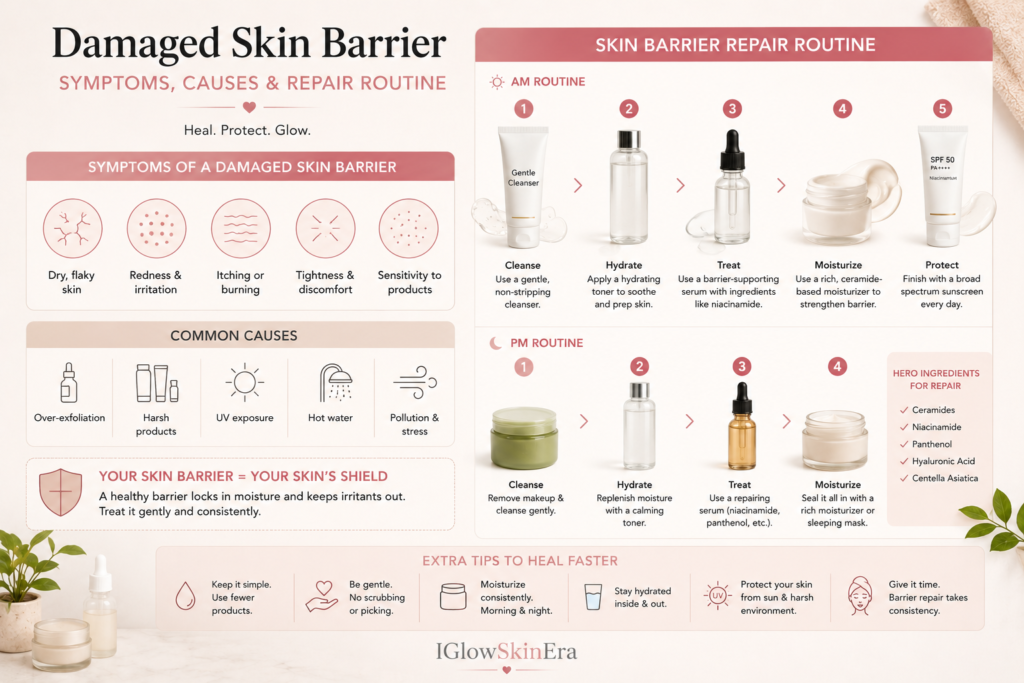
Keep this routine as simple as possible. Simplicity is not a compromise during barrier repair — it is the entire strategy.
☀️ Morning Routine:
- Rinse with lukewarm water only – no cleanser in the morning while repairing
- The Ordinary Hyaluronic Acid 2% + B5 – on slightly damp skin
- CeraVe Moisturising Cream – seal immediately while damp
- SPF 30+ – UV exposure worsens every single damaged skin barrier symptom
🌙 Evening Routine:
- CeraVe Hydrating Cleanser – gentle, non-stripping cleanse
- The Ordinary Niacinamide 10% + Zinc 1% – calms redness and starts rebuilding
- The Ordinary Hyaluronic Acid 2% + B5
- CeraVe Moisturising Cream – generous layer, especially on dry or flaking areas
Timeline to expect:
- Days 1–7: Redness and stinging reduce noticeably
- Weeks 1–2: Flaking improves, products start feeling comfortable again
- Weeks 4–6: Full barrier repair, skin holds moisture normally again
Recommended Products for Damaged Skin Barrier Repair
| Product | What It Does | Why It Is Recommended |
|---|---|---|
| CeraVe Moisturising Cream | Restores ceramides 1, 3 + 6-II | Most complete barrier repair formula available without a prescription |
| The Ordinary Hyaluronic Acid 2% + B5 | Deep hydration + panthenol | Restores moisture levels rapidly depleted by barrier damage |
| The Ordinary Niacinamide 10% + Zinc 1% | Anti-inflammatory, ceramide-building | Reduces redness and rebuilds barrier structure simultaneously |
| CeraVe Hydrating Cleanser | pH-balanced, non-stripping cleanse | Will not worsen damaged skin barrier symptoms the way foaming cleansers do |
| Cetaphil Gentle Skin Cleanser | Ultra-gentle, fragrance-free | Safe even on stinging or burning skin |
| Mighty Patch Original | Treats spots without disturbing the surrounding skin | Safe to use during barrier repair – no additional stress to damaged areas |
FAQs About Damaged Skin Barrier Symptoms
Q: How do I know if I have damaged skin barrier symptoms or just naturally sensitive skin?
Sensitive skin is a skin type – you have likely always had it. A damaged barrier is a condition that develops and changes. The clearest indicator is sudden change: if your skin was tolerating your routine well and then started stinging, breaking out in new places, or reacting to products it used to love, that is a damaged barrier, not just your skin type.
Q: Can damaged skin barrier symptoms get worse before they get better?
Yes, especially if you have been over-exfoliating for a long time. The first week of stopping actives can feel uncomfortable as your skin adjusts to not being constantly stimulated. Stay with the simple barrier routine and do not mistake the adjustment period for the routine failing.
Q: How long does skin barrier repair actually take?
Mild damage: one to two weeks. Moderate damage: four to six weeks. Severe damage where even water stings: up to three months. The biggest mistake people make is reintroducing actives the moment skin feels slightly better – too soon, and you reset the damage cycle.
Q: Is CeraVe Moisturising Cream or the Lotion better for damaged skin barrier symptoms?
The cream, without question. The cream has a significantly richer formula with a higher ceramide concentration than the lotion. For active barrier repair, the cream is the correct choice. The lotion is appropriate for maintenance once your barrier is healthy.
Q: Can I still wear makeup over a damaged skin barrier?
Yes, but choose carefully. Avoid matte, full-coverage, and powder-heavy formulas during repair – they are drying and amplify damaged skin barrier symptoms. A lightweight tinted moisturiser with SPF applied over CeraVe is the safest option while healing.
Q: Will niacinamide specifically help the redness from a damaged skin barrier?
Yes – and it is one of the best single ingredients for this. The Ordinary Niacinamide 10% + Zinc 1% reduces barrier-related redness within about a week of consistent twice-daily use for most people. Crucially, it also stimulates new ceramide production, which means it is treating the cause of the redness, not just masking the symptom.
Q: Can I use The Ordinary Hyaluronic Acid and CeraVe Moisturising Cream together?
Absolutely – this is one of the most recommended combinations for damaged skin barrier recovery. Apply hyaluronic acid to damp skin, then immediately seal with CeraVe cream. The HA draws moisture in, and the CeraVe locks it there with ceramides. They perform significantly better together than either does alone.
Q: What if I have not changed my routine, but damaged skin barrier symptoms appeared anyway?
Environmental triggers are underestimated. Moving into cold or dry weather, spending extended time in air-conditioned environments, or even a period of sustained stress can cause damaged skin barrier symptoms without any change in your skincare routine. Seasonal barrier breakdown in winter months is extremely common and completely unrelated to products.
The Bottom Line on Damaged Skin Barrier Symptoms
If your skin is dry, reactive, sensitive, or breaking out in ways that make no sense – the answer is almost always here. Damaged skin barrier symptoms are behind more unexplained skin problems than anything else, and the solution is consistently simpler than people expect.
Strip back your routine. Hydrate deeply. Restore your ceramides. Give your skin the time it needs.
The products are affordable. The routine is three to four steps. And the results – skin that holds moisture, resists irritation, and actually responds to the ingredients you put on it – are completely achievable.
You do not have bad skin. You have a barrier that needs repairing. And now you know exactly how.
Read next: Skincare Ingredients Not to Mix — 6 Deadly Combos That Wreck Your Skin | The Correct Skincare Routine Order for beginners
Have you been dealing with any of these damaged skin barrier symptoms? Drop it in the comments – you would be surprised how many people are going through the exact same thing.
📌 Pin this to your skincare board — your future self will thank you.

Leave a Reply